Powder Coating Carbon Steel for Oil & Gas Environments
September 1, 2026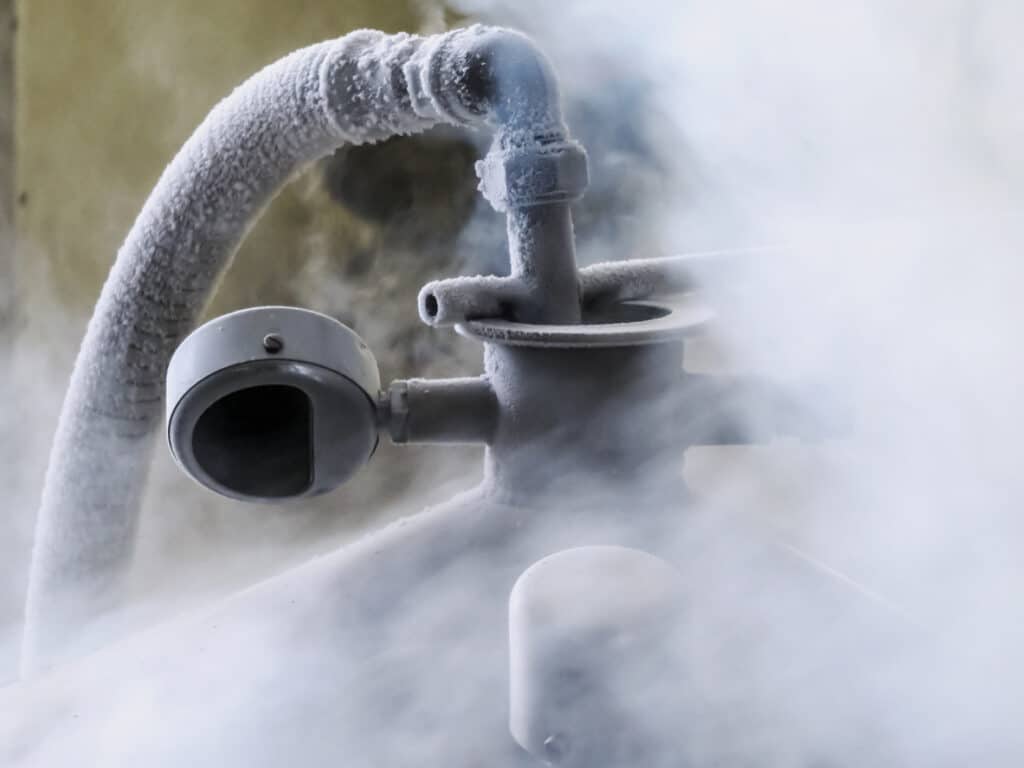
Most people know that heat can change the properties of steel. You heat it up, quench it, temper it, and you end up with a harder, tougher part. But what happens when you go the other direction? What happens when you take steel far below freezing, down to temperatures that make a winter night feel tropical by comparison?
That is exactly what cryogenic heat treatment does. And while it might sound like something out of a science fiction story, it is a well-established metallurgical process with real, measurable benefits for tool steel, automotive components, and a wide range of industrial applications. If you have ever wondered whether your parts could be performing better, this process might be the answer you have been looking for.
What Is Cryogenic Heat Treatment?
Cryogenic heat treatment, sometimes called sub-zero treatment or cryo processing, is a supplemental heat treatment process that takes steel to extremely low temperatures, typically around negative 300 degrees Fahrenheit (negative 184 degrees Celsius), using liquid nitrogen. The steel is cooled slowly, held at that temperature for an extended period, and then brought back up to room temperature before being tempered.
It is important to understand that cryogenic treatment is not a standalone process. It is almost always performed after a conventional hardening cycle, serving as an additional step that picks up where standard heat treatment leaves off. Think of it as finishing what the furnace started.
What Happens Inside the Steel?
To understand why cryogenic treatment works, you need to know a little about what happens to steel during conventional hardening. When steel is heated to its austenitizing temperature and then rapidly quenched, the austenite in the steel transforms into a hard structure called martensite. That martensitic transformation is what gives hardened steel its strength and wear resistance.
The problem is that this transformation is rarely complete. Depending on the alloy and the quench conditions, a portion of the austenite does not convert. This leftover material is called retained austenite, and it is softer and less stable than martensite. Retained austenite can cause several issues in finished parts:
- Reduced hardness compared to what the alloy is theoretically capable of achieving
- Dimensional instability over time, as retained austenite slowly transforms under stress or temperature changes in service
- Lower wear resistance, which shortens the working life of cutting tools, dies, and other high-wear components
Cryogenic treatment addresses this directly. At sub-zero temperatures, the retained austenite that survived the quench is forced to complete its transformation into martensite. The result is a more fully martensitic microstructure with less unstable material left behind.
There is also a second benefit that goes beyond retained austenite conversion. Research has shown that deep cryogenic treatment promotes the precipitation of very fine carbide particles throughout the steel matrix. These eta carbides, as they are often called, are extremely hard and distributed evenly through the microstructure. They act like tiny reinforcing particles embedded in the steel, improving wear resistance in a way that conventional heat treatment simply cannot replicate.
Shallow Cryogenic vs. Deep Cryogenic Treatment
Not all cryogenic processing is the same. There are two general categories, and they differ in temperature range and outcome.
Shallow cryogenic treatment involves cooling steel to around negative 100 to negative 120 degrees Fahrenheit. This range is enough to convert some retained austenite and is sometimes used as a relatively quick sub-zero step in standard heat treating sequences. It provides a modest improvement but does not fully realize the potential of the process.
Deep cryogenic treatment takes the steel all the way down to around negative 300 degrees Fahrenheit. This is the level at which the eta carbide precipitation effect becomes significant. The process also involves controlled ramp rates on the way down and back up, along with a soak time that can last 24 hours or more depending on the material and application. Deep cryogenic treatment is what most professionals in the field are referring to when they talk about the real performance gains from cryo processing.
Which Materials Benefit the Most?
Cryogenic treatment is most commonly applied to high-alloy tool steels, though other materials can benefit as well. The steels that tend to show the greatest improvement are those with higher carbon and alloy content, because they have more potential for retained austenite and more carbide-forming elements to work with.
Some of the most common materials sent for cryogenic processing include:
- D2 tool steel, which is one of the most widely cryo-treated materials due to its high chromium and carbon content and its use in dies, punches, and cutting tools
- A2 tool steel, a versatile air-hardening steel commonly used in dies and precision tooling
- M2 high-speed steel, used extensively in drills, taps, and end mills where tool life is a major concern
- H13 hot work steel, used in die casting dies and extrusion tooling
- 410 stainless steel, which is martensitic and responds well to sub-zero treatment
- 4340 and 4140 alloy steels, depending on the application and hardness target
Engine blocks and other automotive components made from cast iron and steel alloys also respond well to cryogenic processing. In high-performance and racing applications, cryo treatment of engine blocks, cylinder heads, and rotating assemblies has been shown to improve dimensional stability and extend service life.
What Real-World Results Can You Expect?
The performance improvements from cryogenic treatment are not theoretical. They have been documented across a wide range of industrial and manufacturing applications. Here is what users typically report:
- Extended tool life in cutting tools, dies, and punches, often by a factor of two to five times compared to conventionally treated tooling
- Better dimensional stability in precision components that would otherwise shift slightly over time as retained austenite transforms in service
- Improved wear resistance in high-friction applications where surface degradation is a primary failure mode
- More consistent performance across a batch of parts, because cryo treatment treats the entire cross section of the steel, not just the surface
Unlike surface treatments such as nitriding or carburizing, cryogenic treatment is a through-treatment. The benefits extend from the surface all the way to the core. That means even as a cutting tool wears down and material is removed from the surface, the same improved microstructure is present throughout the entire tool.
How Cryogenic Treatment Fits Into a Heat Treat Sequence
Cryogenic treatment does not replace conventional heat treatment. It enhances it. A typical sequence for a tool steel component might look like this:
- Austenitize at the appropriate temperature for the alloy
- Quench to room temperature using oil, air, or gas, depending on the steel
- Perform cryogenic treatment immediately after the quench, before any tempering
- Return the part to room temperature using a controlled warm-up rate
- Temper at the appropriate temperature for the alloy and desired hardness
Timing matters here. Cryogenic treatment is most effective when performed before the first temper, while the steel is in its freshly quenched state. Performing cryo treatment after tempering is still beneficial in some cases, but the results are generally not as strong as when the cryo step precedes tempering.
Some processors also perform a second or even third temper after cryogenic treatment to ensure that any newly formed martensite from the retained austenite conversion is fully stress-relieved and stable. Southwest Metal Treating works with customers to determine the right sequence for their specific alloy and application.
Is Cryogenic Treatment Right for Your Parts?
Cryogenic treatment is a compelling option when any of the following apply to your situation:
- You are using high-alloy or high-carbon tool steel and want to maximize wear life
- Your tooling is failing prematurely from wear rather than from impact or fracture
- You need tight dimensional stability in precision components over time
- You are working with D2, A2, M2, H13, or similar materials that are known to respond well to cryo processing
- You are building or rebuilding performance engine components and want improved longevity
It is also worth noting that cryogenic treatment is permanent. Unlike some coatings or surface treatments that wear away, the microstructural changes produced by cryo processing are part of the steel itself. You do not need to reapply them. That makes cryogenic treatment a one-time investment with long-term returns on every part that goes through the process.
Take the Next Step Toward Longer-Lasting Parts
If your tooling is wearing out faster than it should, or if you are looking for every advantage in precision and performance, cryogenic heat treatment is a process worth exploring seriously. The science is sound, the results are well-documented, and the process is straightforward to incorporate into your existing heat treat sequence. Reach out to Southwest Metal Treating today to discuss your parts, your materials, and your performance goals. A conversation with our team can help you figure out whether cryogenic treatment is the right next step, and get your components performing at the level they were always capable of reaching.